
When most people think of Radon gas, they think of basements on the East Coast or the Midwest. It is a common misconception among Southern California homeowners and even some real estate agents: “We don’t have basements, and we have great weather, so Radon isn’t an issue here.”
At CIS Home Inspections, we are here to tell you that this myth can be dangerous to your health.
While it is true that Radon is less common in California than in other parts of the country, it is certainly not absent. In fact, the unique geology of the Santa Monica Mountains and the San Fernando Valley makes certain neighborhoods in Calabasas and Hidden Hills susceptible to elevated Radon levels.
What is Radon and Why Should You Care?
Radon is a naturally occurring radioactive gas. You cannot see it, smell it, or taste it. It comes from the natural breakdown of uranium in soil, rock, and water. As it breaks down, it seeps up from the ground and into the air.
Outside, it disperses harmlessly. But inside a home, it can get trapped and build up to dangerous levels.
The Health Risk: According to the EPA and the Surgeon General, Radon is the second leading cause of lung cancer in the United States, responsible for about 21,000 deaths annually. If you are a non-smoker, it is the #1 cause of lung cancer.
The Geology of Calabasas: Why Being “On the Hill” Matters
Many of the beautiful homes in our service area—Calabasas, Topanga, Malibu—are built directly into the hillsides. These hills are comprised of sedimentary rock and shale, which can contain uranium deposits.
Because many local homes are built on slab foundations directly over this soil (or with cut-in basements/wine cellars in hillside estates), the gas moves through cracks in the foundation, gaps around service pipes, and construction joints.
The “Neighbor” Myth: A common mistake is assuming that because your neighbor tested low, your house is safe. Radon is notoriously “spotty.” It depends on the specific soil composition directly under your footprint. One house can test safe, and the house next door can test at dangerous levels.
How We Test: Fast, Accurate, and Non-Invasive
The good news is that testing is simple and affordable. You don’t need to tear up your floors or drill holes.
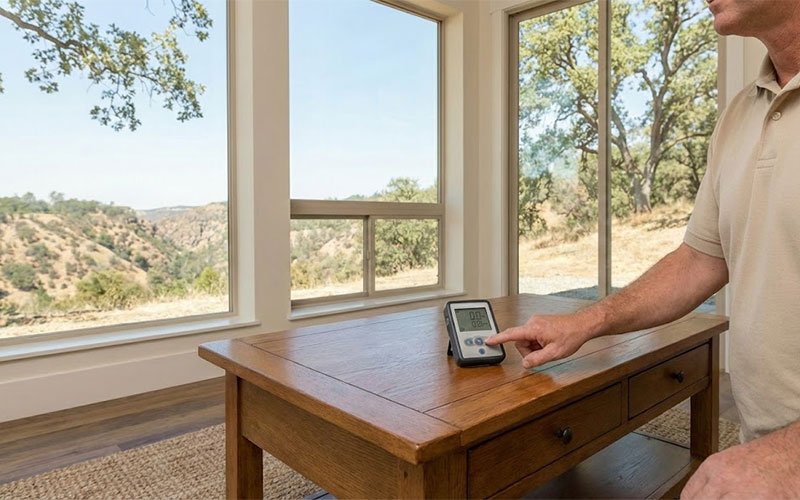
At CIS Home Inspections, we use professional Continuous Radon Monitors (CRM). Here is the process:
- Placement: We place a small, unobtrusive device in the lowest livable level of the home.
- The Wait: The device sits for 48 hours collecting data. It takes hourly readings to account for fluctuations in temperature and barometric pressure.
- The Results: After 48 hours, we pick up the device and generate an instant report. You will know immediately if the home is above the EPA action level of 4.0 pCi/L.
What If The Levels Are High?
Finding high Radon levels is not a reason to walk away from a dream home. Radon is easily fixable.
Mitigation systems (usually a vent pipe and a fan that sucks air from under the foundation and vents it above the roofline) are standard, effective, and relatively inexpensive compared to other home repairs. The key is simply knowing so you can negotiate the credit for the mitigation system.
Don’t leave your family’s health to chance or outdated myths. Add a Radon Test to your inspection and breathe easy.
Is your home safe?
Add a 48-hour Radon Test to your CIS Home Inspection package today.
📞 (818) 421-5746
🌐 www.cisinspecthomes.com
📍 Serving Calabasas, Woodland Hills, and the Greater Los Angeles Area.