
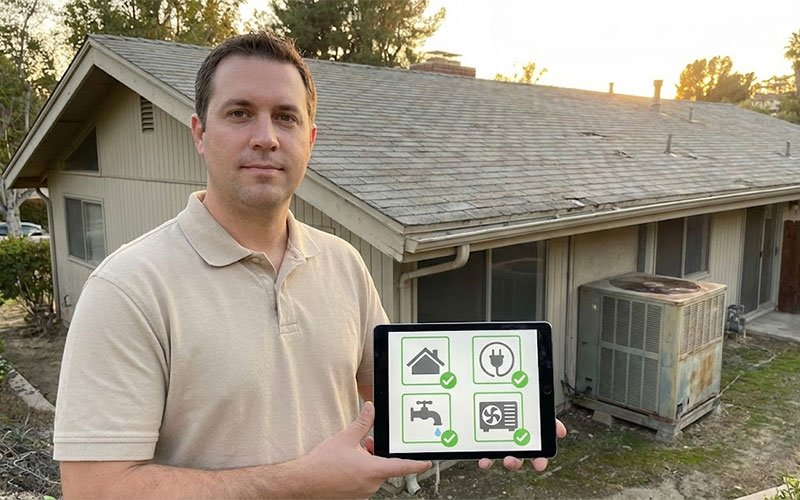
You have found the perfect mid-century modern home in Woodland Hills. You are in escrow, everything is moving smoothly, and then your insurance agent drops a bomb: “We need a 4-Point Inspection before we can bind the policy.”
Many homebuyers are confused by this request. “I already paid for a full home inspection! Why do I need another one?”
At CIS Home Inspections, we perform these regularly. Here is everything you need to know about the 4-Point Inspection, why insurers demand it for older homes, and what we look for.
What Is a 4-Point Inspection?
Unlike a “Full Home Inspection,” which is a comprehensive dive into every nook and cranny of the house for your benefit, a 4-Point Inspection is a limited snapshot designed for the insurance company’s benefit.
It focuses exclusively on the four systems that cause the most frequent (and expensive) insurance claims:
- Roofing
- Electrical
- Plumbing
- HVAC (Heating, Ventilation, and Air Conditioning)
Typically, insurance companies require this for homes that are 30 years or older. They want to know if these systems have been updated or if they are original ticking time bombs.
The Breakdown: What We Check
1. Roofing (The First Line of Defense)
Insurers hate water damage. We inspect the roof specifically to estimate its remaining life. If your roof is nearing the end of its lifespan (e.g., an asphalt shingle roof that is 20+ years old) or has missing tiles, the insurer may require you to replace it before they will insure you.
2. Electrical (The Fire Risk)
This is the most critical category. We are looking for outdated wiring types that are known fire hazards. If we find any of the following, you may have trouble getting coverage:
- Knob and Tube Wiring: Common in pre-1950s homes.
- Aluminum Branch Wiring: A fire hazard common in mid-60s to mid-70s homes.
- Recall Panels: Brands like Federal Pacific Electric (FPE) or Zinsco, which have high failure rates.
3. Plumbing (The Water Damage Risk)
We look at the material of the supply and drain lines. Insurers are wary of Galvanized Steel pipes (which rust from the inside out and eventually burst) or Polybutylene pipes. They prefer to see updated Copper or PEX piping.
4. HVAC (The Safety Risk)
We check to ensure the home has a functioning heating source (mandatory for habitability) and that it is safe. We look for gas leaks, proper venting, and make sure there are no fire hazards, such as a furnace installed directly on a wood floor without protection.
4-Point vs. Full Inspection: Do You Need Both?
Yes.
A 4-Point Inspection is a “Pass/Fail” report for the insurance company. It does not tell you if the windows are stuck, if the dishwasher is broken, or if there is mold in the crawlspace.
Think of it this way:
- Full Inspection: A 50+ page manual for you on how to maintain your new home.
- 4-Point Inspection: A 4-page report for the bank/insurer to prove the house isn’t going to burn down or flood next week.
Don’t Let Insurance Stall Your Closing
If you are buying an older home, ask your insurance agent early if a 4-Point Inspection will be required. If so, we can often perform it at the same time as your full inspection, saving you time and money.
Need a 4-Point Inspection?
We work directly with insurance agents to provide the exact data they need.
📞 (818) 421-5746
🌐 www.cisinspecthomes.com
📍 Serving Calabasas, Woodland Hills, and the Greater Los Angeles Area.