
“But we live in a desert!”
This is the most common reaction we hear from clients when we suggest a mold inspection. It is a logical assumption: mold needs moisture, and Calabasas is known for its dry, sunny weather, not humid swamps.
However, as professional home inspectors in the San Fernando Valley, we find mold more often than you might think. In Southern California, mold doesn’t usually come from the weather outside—it comes from the systems inside your walls.
The “Micro-Climate” Behind Your Walls
While the air outside might be 10% humidity, the environment behind your kitchen cabinets or under your master bath tub can be a tropical rainforest if there is a leak.
In our dry climate, water evaporates quickly from surfaces. If a pipe leaks, you might not see a puddle on the floor because it dries up. But inside the wall cavity, where there is no airflow and no sunlight, that moisture gets trapped. It soaks into the drywall, insulation, and wood framing, creating the perfect breeding ground for mold spores.
The Top 3 Culprits in Calabasas Homes
Through our inspections at CIS Home Inspections, we have identified the most frequent causes of hidden mold in our area:
1. Air Conditioning Condensate Lines
In the Valley, our AC units run hard. These units pull moisture out of the air, which drains through a “condensate line.” If this line gets clogged (which is common), water backs up and drips into the attic or ceiling. Because it’s often in a remote part of the house, it can leak for months before you notice a stain.
2. The “Slow Drip” Under Sinks
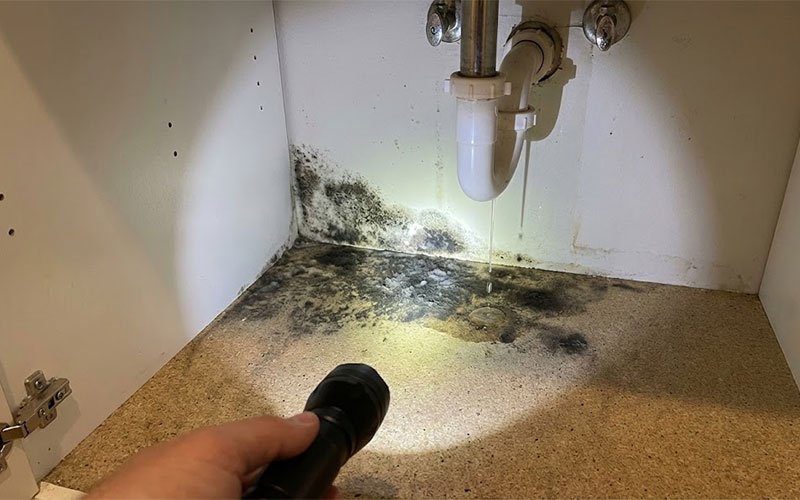
A burst pipe is obvious. A slow drip from a loose P-trap or a failing garbage disposal seal is silent. It slowly saturates the cabinet wood. By the time you smell that musty odor, the mold colony is often well-established.
3. Shower Pan Failures
In second-story bathrooms, a small crack in the shower pan or grout allows water to seep into the subfloor every time you shower. You won’t see it in the bathroom, but the ceiling below might start showing bubbling paint—a telltale sign of moisture intrusion.
Why “Just Bleaching It” Doesn’t Work
Many homeowners see a spot of black mold and wipe it with bleach. Unfortunately, this only kills the surface mold. Mold has roots (hyphae) that grow deep into porous materials like drywall. Bleach cannot reach these roots.
Furthermore, the visible mold is often just the “tip of the iceberg.” If there is mold on the outside of the wall, there is almost certainly much more on the inside.
How We Test for the Invisible
You don’t have to tear down walls to check for mold. At CIS Home Inspections, we use non-invasive scientific testing methods:
- Air Quality Sampling: We take air samples inside the home and compare them to an outdoor control sample. If the indoor spore count is significantly higher than the outdoor count, we know there is an active mold source inside.
- Surface Swabs: If we see a suspicious substance, we can swab it and send it to a lab to identify exactly what type of mold it is (including toxic varieties like Stachybotrys, or “black mold”).
Protect Your Health
Mold isn’t just a structural issue; it’s a health issue. It can trigger allergies, asthma, and respiratory problems. Don’t let the dry weather fool you.
If you suspect a leak, or if you are buying a home that has been vacant (where lack of airflow accelerates mold growth), ask us about adding Mold Testing to your inspection.
Breathe easier in your new home.
Contact CIS Home Inspections to schedule your inspection today.
📞 (818) 421-5746
🌐 www.cisinspecthomes.com
📍 Serving Calabasas, Woodland Hills, and the Greater Los Angeles Area.